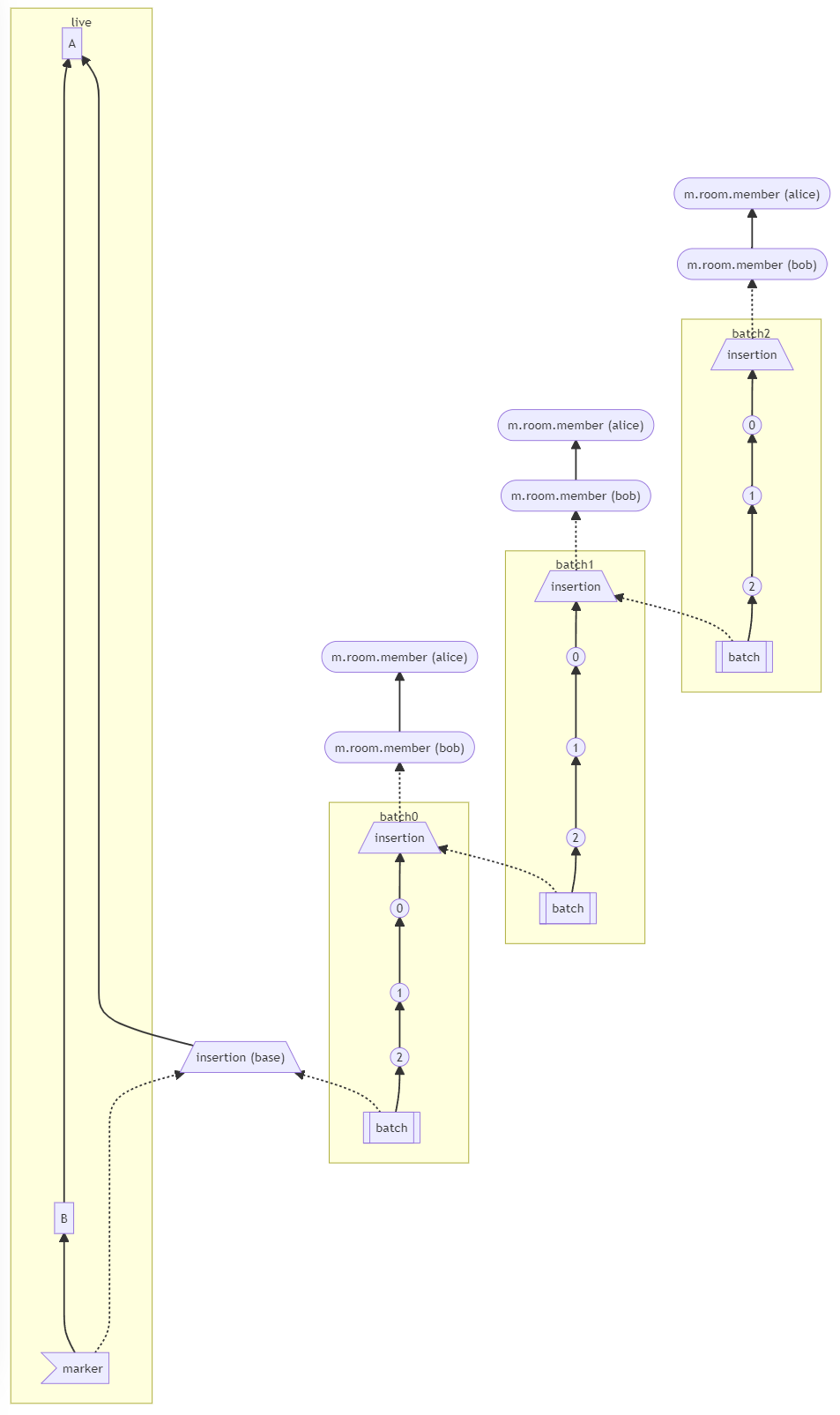
Follow-up to https://github.com/matrix-org/synapse/pull/12083
Since we are now using the new `state_event_ids` parameter to do all of the heavy lifting.
We can remove any spots where we plumbed `auth_event_ids` just for MSC2716 things in
https://github.com/matrix-org/synapse/pull/9247/files.
Removing `auth_event_ids` from following functions:
- `create_and_send_nonmember_event`
- `_local_membership_update`
- `update_membership`
- `update_membership_locked`
When we are processing a `/backfill` request from a remote server, exclude any
outliers from consideration early on. We can't return outliers anyway (since we
don't know the state at the outlier), and filtering them out earlier means that
we won't attempt to calulate the state for them.
This should speed up push rule calculations for rooms with large numbers of local users when the main push rule cache fails.
Co-authored-by: reivilibre <oliverw@matrix.org>
* Make it possible to enable compression for the metrics HTTP resource
This can provide significant bandwidth savings pulling metrics from
synapse instances.
* Add changelog file.
* Fix type hint
We fetch the thread summary in two phases:
1. The summary that is shared by all users (count of messages and latest event).
2. Whether the requesting user has participated in the thread.
There's no use in attempting step 2 for events which did not return a summary
from step 1.
* Formally type the UserProfile in user searches
* export UserProfile in synapse.module_api
* Update docs
Co-authored-by: Sean Quah <8349537+squahtx@users.noreply.github.com>
An error occured if a filter was supplied with `event_fields` which did not include
`unsigned`.
In that case, bundled aggregations are still added as the spec states it is allowed
for servers to add additional fields.
To handle cancellation, we ensure that `after_callback`s and
`exception_callback`s are always run, since the transaction will
complete on another thread regardless of cancellation.
We also wait until everything is done before releasing the
`CancelledError`, so that logging contexts won't get used after they
have been finished.
Signed-off-by: Sean Quah <seanq@element.io>
* Moves the relation pagination tests to a separate class.
* Move the assertion of the response code into the `_send_relation` helper.
* Moves some helpers into the base-class.
These decorators mostly support cancellation already. Add cancellation
tests and fix use of finished logging contexts by delaying cancellation,
as suggested by @erikjohnston.
Signed-off-by: Sean Quah <seanq@element.io>
`delay_cancellation` behaves like `stop_cancellation`, except it
delays `CancelledError`s until the original `Deferred` resolves.
This is handy for unifying cleanup paths and ensuring that uncancelled
coroutines don't use finished logcontexts.
Signed-off-by: Sean Quah <seanq@element.io>
The unstable identifiers are still supported if the experimental configuration
flag is enabled. The unstable identifiers will be removed in a future release.
This is allowed per MSC2675, although the original implementation did
not allow for it and would return an empty chunk / not bundle aggregations.
The main thing to improve is that the various caches get cleared properly
when an event is redacted, and that edits must not leak if the original
event is redacted (as that would presumably leak something similar to
the original event content).
Since the object it returns is a ReplicationCommandHandler.
This is clean-up from adding support to Redis where the command handler
was added as an additional layer of abstraction from the TCP protocol.
* `@cached` can now take an `uncached_args` which is an iterable of names to not use in the cache key.
* Requires `@cached`, @cachedList` and `@lru_cache` to use keyword arguments for clarity.
* Asserts that keyword-only arguments in cached functions are not accepted. (I tested this briefly and I don't believe this works properly.)
This allows for the target process to be down for around a minute
which provides time for restarts during synapse upgrades/config updates.
Closes: #12178
Signed off by Nick Mills-Barrett nick@beeper.com
* Rewrites the demo documentation to be clearer, accurate, and moves it to our documentation tree.
* Improvements to the demo scripts:
* `clean.sh` now runs `stop.sh` first to avoid zombie processes.
* Uses more modern Synapse configuration (and removes some obsolete configuration).
* Consistently use the HTTP ports for server name, etc.
* Remove the `demo/etc` directory and place everything into the `demo/808x` directories.
This field is only to be used in the Server-Server API, and not the
Client-Server API, but was being leaked when a federation response
was used in the /hierarchy API.
It’s just occurred to me that #12088 pulled in the “packaging” package (~=21.3). I pulled in the newest version I had at the time.
I only use it for packaging.requirements.Requirements. Which was added in packaging 16.1: https://github.com/pypa/packaging/releases/tag/16.1https://pkgs.org/download/python3-packaging suggests that the oldest version we care about is 17.1 in Ubuntu Bionic. So I think with this bound we're hunky dory.
If we locally generate a rejection for an invite received over federation, it
is stored as an outlier (because we probably don't have the state for the
room). However, currently we still generate a state group for it (even though
the state in that state group will be nonsense).
By setting the `outlier` param on `create_event`, we avoid the nonsensical
state.
I've argued in #11537 that poetry and tox don't cooperate well at the
moment. (See also #12119.) Therefore I'm pruning away bits of tox to make the transition to poetry easier. This change removes the commands for coverage.
We don't use coverage in anger at the moment. It shouldn't be too hard to add coverage as a dev-dependency and reintroduce this if we really want it.
* Fix incorrect argument in test case
* Add copyright header
* Docstring and __all__
* Exclude dev depenencies
* Use changelog from #12088
* Include version in error messages
This will hopefully distinguish between the version of the source code
and the version of the distribution package that is installed.
* Linter script is your friend
* Move the `snapcraft` configuration to `contrib`.
We're happy for people to package this as a snap image if it's useful,
but we don't support or maintain it. I'd like to move the config to
`contrib` to reflect this state of affairs.
* Changelog
* Remove unused mocks from `test_typing`
It's not clear what these do. `get_user_by_access_token` has the wrong
signature, including the return type. Tests all pass without these. I
think we should nuke them.
* Changelog
* Fixup imports
* Add type hints to `tests/rest/client`
* newsfile
* fix imports
* add `test_account.py`
* Remove one type hint in `test_report_event.py`
* change `on_create_room` to `async`
* update new functions in `test_third_party_rules.py`
* Add `test_filter.py`
* add `test_rooms.py`
* change to `assertEquals` to `assertEqual`
* lint
* Two scripts are basically entry_points already
* Move and rename scripts/* to synapse/_scripts/*.py
* Delete sync_room_to_group.pl
* Expose entry points in setup.py
* Update linter script and config
* Fixup scripts & docs mentioning scripts that moved
Co-authored-by: Andrew Morgan <1342360+anoadragon453@users.noreply.github.com>
* Pull runtime dep checks into their own module
* Reimplement `check_requirements` using `importlib`
I've tried to make this clearer. We start by working out which of
Synapse's requirements we need to be installed here and now. I was
surprised that there wasn't an easier way to see which packages were
installed by a given extra.
I've pulled out the error messages into functions that deal with "is
this for an extra or not". And I've rearranged the loop over two
different sets of requirements into one loop with a "must be instaled"
flag.
I hope you agree that this is clearer.
* Test cases
When we get a partial_state response from send_join, store information in the
database about it:
* store a record about the room as a whole having partial state, and stash the
list of member servers too.
* flag the join event itself as having partial state
* also, for any new events whose prev-events are partial-stated, note that
they will *also* be partial-stated.
We don't yet make any attempt to interpret this data, so API calls (and a bunch
of other things) are just going to get incorrect data.
* Fix 'Unhandled error in Deferred'
Fixes a CRITICAL "Unhandled error in Deferred" log message which happened when
a function wrapped with `@cachedList` failed
* Minor optimisation to cachedListDescriptor
we can avoid re-using `missing`, which saves looking up entries in
`deferreds_map`, and means we don't need to copy it.
* Improve type annotation on CachedListDescriptor
* fix incorrect unwrapFirstError import
this was being imported from the wrong place
* Refactor `concurrently_execute` to use `yieldable_gather_results`
* Improve exception handling in `yieldable_gather_results`
Try to avoid swallowing so many stack traces.
* mark unwrapFirstError deprecated
* changelog
...and various code supporting it.
The /spaces endpoint was from an old version of MSC2946 and included
both a Client-Server and Server-Server API. Note that the unstable
/hierarchy endpoint (from the final version of MSC2946) is not yet
removed.
* Fix `PushRuleEvaluator` to work on frozendicts
frozendicts do not (necessarily) inherit from dict, so this needs to handle
them correctly.
* Fix event filtering for frozen events
Looks like this one was introduced by #11194.
Before this fix, a legitimate 404 from a federation endpoint (e.g. due
to an unknown room) would be treated as an unknown endpoint. This
could cause unnecessary federation traffic.
Don't attempt to add non-string `value`s to `event_search` and add a
background update to clear out bad rows from `event_search` when
using sqlite.
Signed-off-by: Sean Quah <seanq@element.io>
The complement.sh script relies on the name of the ref matching the name
of the unpacked folder. The branch redirect from renaming the default
branch breaks that assumption.
Signed-off-by: Nicolas Werner <n.werner@famedly.com>
* Remove `trial` section from setup.cfg
This was added in the initial commit from 2014. I can't see that it does
anything. Maybe it's there so that you can run `trial` without any extra
args, but if I do that then I just get the `--help` message.
* Move flake8's config to its own file
This is an endpoint that we have server-side support for, but no client-side support. It's going to be useful for resyncing partial-stated rooms, so let's introduce it.
msc3706 proposes changing the `/send_join` response:
> Any events returned within `state` can be omitted from `auth_chain`.
Currently, we rely on `m.room.create` being returned in `auth_chain`, but since
the `m.room.create` event must necessarily be part of the state, the above
change will break this.
In short, let's look for `m.room.create` in `state` rather than `auth_chain`.
For users with large accounts it is inefficient to calculate the set of
users they share a room with (and takes a lot of space in the cache).
Instead we can look at users whose devices have changed since the last
sync and check if they share a room with the syncing user.
When the server leaves a room the `get_rooms_for_user` cache is not
correctly invalidated for the remote users in the room. This means that
subsequent calls to `get_rooms_for_user` for the remote users would
incorrectly include the room (it shouldn't be included because the
server no longer knows anything about the room).
The driver for this is to stop Complement complaining about it, but as far as I can tell it was pointless and needed to go away anyway.
I'm a bit unclear about what exactly VOLUME does, but I think what it means is that, if you don't override it with an explicit -v argument, then docker run will create a temporary volume, and copy things into it. The temporary volume is then deleted when the container finishes.
That only sounds useful if your image has something to copy into it (otherwise you may as well just use the default root filesystem), and our image notably doesn't copy anything into /data.
So... this wasn't doing anything, except annoying Complement?
Splits the search code into a few logical functions instead of a single
unreadable function.
There are also a few additional changes for readability.
After refactoring it was clear to see there were some unused and
unnecessary variables, which were simplified.
If the latest event in a thread was edited than the original
event content was included in bundled aggregation for
threads instead of the edited event content.
* Make `get_auth_chain_ids` return a Set
It has a set internally, and a set is often useful where it gets used, so let's
avoid converting to an intermediate list.
* Minor refactors in `on_send_join_request`
A little bit of non-functional groundwork
* Implement MSC3706: partial state in /send_join response
This should reduce database usage when fetching bundled aggregations
as the number of individual queries (and round trips to the database) are
reduced.
If ther are more than 100 to-device messages pending for a device
`/sync` will only return the first 100, however the next batch token was
incorrectly calculated and so all other pending messages would be
dropped.
This is due to `txn.rowcount` only returning the number of rows that
*changed*, rather than the number *selected* in SQLite.
If we prepopulate the test homeserver with a key for a remote homeserver, we
can make federation requests to it without having to stub out the
authenticator. This has two advantages:
* means that what we are testing is closer to reality (ie, we now have
complete tests for the incoming-request-authorisation flow)
* some tests require that other objects be signed by the remote server (eg,
the event in `/send_join`), and doing that would require a whole separate
set of mocking out. It's much simpler just to use real keys.
This implements an allow list for content types for which Synapse will attempt URL preview. If a URL resolves to a resource with a content type which isn't in the list, the download will terminate immediately.
This makes sense given that Synapse would never successfully generate a URL preview for such files in the first place, and helps prevent issues with streaming media servers, such as #8302.
Signed-off-by: Denis Kasak dkasak@termina.org.uk
This should reduce database usage when fetching bundled aggregations
as the number of individual queries (and round trips to the database) are
reduced.
Part of the Tchap Synapse mainlining.
This allows modules to implement extra logic to figure out whether a given 3PID can be added to the local homeserver. In the Tchap use case, this will allow a Synapse module to interface with the custom endpoint /internal_info.
Since #11811 there has been general Complement flakiness around networking.
It seems like tests are hitting the wrong containers. In an effort to diagnose
the cause of this, as well as reduce its impact on this project, set the
parallelsim to 1 (no parallelism) when running tests.
If this fixes the flakiness then this indicates the cause and I can diagnose
this further. If this doesn't fix the flakiness then that implies some kind
of test pollution which also helps to diagnose this further.
The idea here is to set the parent span for incoming federation requests to the
*outgoing* span on the other end. That means that you can see (most of) the
full end-to-end flow when you have a process that includes federation requests.
However, in order not to lose information, we still want a link to the
`incoming-federation-request` span from the servlet, so we have to create
another span to do exactly that.
`start_active_span` was inconsistent as to whether it would activate the span
immediately, or wait for `scope.__enter__` to happen (it depended on whether
the current logcontext already had an associated scope). The inconsistency was
rather confusing if you were hoping to set up a couple of separate spans before
activating either.
Looking at the other implementations of opentracing `ScopeManager`s, the
intention is that it *should* be activated immediately, as the name
implies. Indeed, the idea is that you don't have to use the scope as a
contextmanager at all - you can just call `.close` on the result. Hence, our
cleanup has to happen in `.close` rather than `.__exit__`.
So, the main change here is to ensure that `start_active_span` does activate
the span, and that `scope.close()` does close the scope.
We also add some tests, which requires a `tracer` param so that we don't have
to rely on the global variable in unit tests.
The get_users_in_room and get_users_in_room_with_profiles
are now only invalidated when the membership of a room changes,
instead of during any state change in the room.
* Fix losing incoming EDUs if debug logging enabled
Fixes#11889. Homeservers should only be affected if the
`synapse.8631_debug` logger was enabled for DEBUG mode.
I am not sure if this merits a bugfix release: I think the logging can
be disabled in config if anyone is affected? But it is still pretty bad.
Only allow files which file size and content types match configured
limits to be set as avatar.
Most of the inspiration from the non-test code comes from matrix-org/synapse-dinsic#19
This is in the context of mainlining the Tchap fork of Synapse. Currently in Tchap usernames are derived from the user's email address (extracted from the UIA results, more specifically the m.login.email.identity step).
This change also exports the check_username method from the registration handler as part of the module API, so that a module can check if the username it's trying to generate is correct and doesn't conflict with an existing one, and fallback gracefully if not.
Co-authored-by: David Robertson <davidr@element.io>
This is some odds and ends found during the review of #11791
and while continuing to work in this code:
* Return attrs classes instead of dictionaries from some methods
to improve type safety.
* Call `get_bundled_aggregations` fewer times.
* Adds a missing assertion in the tests.
* Do not return empty bundled aggregations for an event (preferring
to not include the bundle at all, as the docstring states).
This is mostly motivated by the tchap use case, where usernames are automatically generated from the user's email address (in a way that allows figuring out the email address from the username). Therefore, it's an issue if we respond to requests on /register and /register/available with M_USER_IN_USE, because it can potentially leak email addresses (which include the user's real name and place of work).
This commit adds a flag to inhibit the M_USER_IN_USE errors that are raised both by /register/available, and when providing a username early into the registration process. This error will still be raised if the user completes the registration process but the username conflicts. This is particularly useful when using modules (https://github.com/matrix-org/synapse/pull/11790 adds a module callback to set the username of users at registration) or SSO, since they can ensure the username is unique.
More context is available in the PR that introduced this behaviour to synapse-dinsic: matrix-org/synapse-dinsic#48 - as well as the issue in the matrix-dinsic repo: matrix-org/matrix-dinsic#476
Similar to #11817.
In `_create_power_level_validator` we
- retrieve `validator`. This is a class implementing the
`jsonschema.protocols.Validator` interface. In other words,
`validator: Type[jsonschema.protocols.Validator]`.
- we then create an second validator class by modifying the original
`validator`. We return that class, which is also of type
`Type[jsonschema.protocols.Validator]`.
So the original annotation was incorrect: it claimed we were returning
an instance of jsonSchema.Draft7Validator, not the class (or a subclass)
itself. (Strictly speaking this is incorrect, because `POWER_LEVELS_SCHEMA`
isn't pinned to a particular version of JSON Schema. But there are other
complications with the type stubs if you try to fix this; I felt like
the change herein was a decent compromise that better expresses intent).
(I suspect/hope the typeshed project would welcome an effort to improve
the jsonschema stubs. Let's see if I get some spare time.)
* add check that gc.freeze is available before calling
* newsfragment
* lint
* Update comment
Co-authored-by: Dan Callahan <danc@element.io>
Co-authored-by: Dan Callahan <danc@element.io>
* CI: run Complement on the VM, not inside Docker
This requires https://github.com/matrix-org/complement/pull/289
We now run Complement on the VM instead of inside a Docker container.
This is to allow Complement to bind to any high-numbered port when it
starts up its own federation servers. We want to do this to allow for
more concurrency when running complement tests. Previously, Complement
only ever bound to `:8448` when running its own federation server. This
prevented multiple federation tests running at the same time as they would
fight each other on the port. This did however allow Complement to run
in Docker, as the host could just port forward `:8448` to allow homeserver
containers to communicate to Complement. Now that we are using random
ports however, we cannot use Docker to run Complement. This ends up
being a good thing because:
- Running Complement tests locally is closer to how they run in CI.
- Allows the `CI` env var to be removed in Complement.
- Slightly speeds up runs as we don't need to pull down the Complement
image prior to running tests. This assumes GHA caches actions sensibly.
* Changelog
* Full stop
* Update .github/workflows/tests.yml
Co-authored-by: Richard van der Hoff <1389908+richvdh@users.noreply.github.com>
* Review comments
* Update .github/workflows/tests.yml
Co-authored-by: Richard van der Hoff <1389908+richvdh@users.noreply.github.com>
Co-authored-by: Richard van der Hoff <1389908+richvdh@users.noreply.github.com>
* Docs: add missing PR submission process how-tos
The documentation says that in order to submit a pull request you have to run the linter and links to [Run the linters](https://matrix-org.github.io/synapse/latest/development/contributing_guide.html#run-the-linters). IMO "Run the linters" should explain that development dependencies are a pre-requisite.
I also included `pip install wheel` which I had to run inside my virtual environment on ubuntu before I `pip install -e ".[all,dev]"` would succeed.
It had already accounted for 1.50.2 (ordered chronologically rather than
sem-ver-ically); it just seems this wasn't merged into master when we
released 1.50.2.
PyNaCl's recent 1.5.0 release on PyPi includes arm64 wheels, which means our
arm64 docker images now build in a sensible amount of time, so we can skip the
amd64-only build.
Synapse 1.51.0rc2 (2022-01-24)
==============================
Bugfixes
--------
- Fix a bug introduced in Synapse 1.40.0 that caused Synapse to fail to process incoming federation traffic after handling a large amount of events in a v1 room. ([\#11806](https://github.com/matrix-org/synapse/issues/11806))
* remove reference in comments to python3.6
* upgrade tox python env in script
* bump python version in example for completeness
* upgrade python version requirement in setup doc
* upgrade necessary python version in __init__.py
* upgrade python version in setup.py
* newsfragment
* drops refs to bionic and replace with focal
* bump refs to postgres 9.6 to 10
* fix hanging ci
* try installing tzdata first
* revert change made in b979f336
* ignore new random mypy error while debugging other error
* fix lint error for temporary workaround
* revert change to install list
* try passing env var
* export debian frontend var?
* move line and add comment
* bump pillow dependency
* bump lxml depenency
* install libjpeg-dev for pillow
* bump automat version to one compatible with py3.8
* add libwebp for pillow
* bump twisted trunk python version
* change suffix of newsfragment
* remove redundant python 3.7 checks
* lint
Debug for #8631.
I'm having a hard time tracking down what's going wrong in that issue.
In the reported example, I could see server A sending federation traffic
to server B and all was well. Yet B reports out-of-sync device updates
from A.
I couldn't see what was _in_ the events being sent from A to B. So I
have added some crude logging to track
- when we have updates to send to a remote HS
- the edus we actually accumulate to send
- when a federation transaction includes a device list update edu
- when such an EDU is received
This is a bit of a sledgehammer.
Warn against using a Let's Encrypt certificate for TLS/DTLS TURN server client connections, and suggest using ZeroSSL certificate instead. This bypasses client-side connectivity errors caused by WebRTC libraries that reject Let's Encrypt certificates. Contibuted by @AndrewFerr.
Fix a bug where the only the first 50 rooms from a space were returned from the `/hierarchy` API. This has existed since the introduction of the API in Synapse v1.41.0.
Fix a bug introduced in Synapse v1.18.0 where password reset and address validation emails would not be sent if their subject was configured to use the 'app' template variable. Contributed by @br4nnigan.
Fix a bug introduced in Synapse v1.18.0 where password reset and address validation emails would not be sent if their subject was configured to use the 'app' template variable. Contributed by @br4nnigan.
The demo start.sh will start three synapse servers on ports 8080, 8081 and 8082, with host names localhost:$port. This can be easily changed to `hostname`:$port in start.sh if required.
To enable the servers to communicate untrusted ssl certs are used. In order to do this the servers do not check the certs
and are configured in a highly insecure way. Do not use these configuration files in production.
stop.sh will stop the synapse servers and the webclient.
Logs and sqlitedb will be stored in demo/808{0,1,2}.{log,db}
Also note that when joining a public room on a different HS via "#foo:bar.net", then you are (in the current impl) joining a room with room_id "foo". This means that it won't work if your HS already has a room with that name.
To use it, you will need to authenticate by providing an `access_token` for a
server admin: [Admin API](../usage/administration/admin_api)
An empty JSON dict is returned.
An empty JSON dict is returned.
```json
```json
@@ -1192,7 +1143,5 @@ The API is:
GET /_synapse/admin/v1/username_available?username=$localpart
GET /_synapse/admin/v1/username_available?username=$localpart
```
```
The request and response format is the same as the [/_matrix/client/r0/register/available](https://matrix.org/docs/spec/client_server/r0.6.0#get-matrix-client-r0-register-available) API.
The request and response format is the same as the
@@ -55,6 +55,7 @@ setup a *virtualenv*, as follows:
cd path/where/you/have/cloned/the/repository
cd path/where/you/have/cloned/the/repository
python3 -m venv ./env
python3 -m venv ./env
source ./env/bin/activate
source ./env/bin/activate
pip install wheel
pip install -e ".[all,dev]"
pip install -e ".[all,dev]"
pip install tox
pip install tox
```
```
@@ -116,7 +117,7 @@ The linters look at your code and do two things:
- ensure that your code follows the coding style adopted by the project;
- ensure that your code follows the coding style adopted by the project;
- catch a number of errors in your code.
- catch a number of errors in your code.
They're pretty fast, don't hesitate!
The linter takes no time at all to run as soon as you've [downloaded the dependencies into your python virtual environment](#4-install-the-dependencies).
```sh
```sh
source ./env/bin/activate
source ./env/bin/activate
@@ -457,6 +458,17 @@ Git allows you to add this signoff automatically when using the `-s`
flag to `git commit`, which uses the name and email set in your
flag to `git commit`, which uses the name and email set in your
`user.name` and `user.email` git configs.
`user.name` and `user.email` git configs.
### Private Sign off
If you would like to provide your legal name privately to the Matrix.org
Foundation (instead of in a public commit or comment), you can do so
by emailing your legal name and a link to the pull request to
Requires you to have a [Synapse development environment setup](https://matrix-org.github.io/synapse/develop/development/contributing_guide.html#4-install-the-dependencies).
The demo setup allows running three federation Synapse servers, with server
names `localhost:8080`, `localhost:8081`, and `localhost:8082`.
You can access them via any Matrix client over HTTP at `localhost:8080`,
`localhost:8081`, and `localhost:8082` or over HTTPS at `localhost:8480`,
`localhost:8481`, and `localhost:8482`.
To enable the servers to communicate, self-signed SSL certificates are generated
and the servers are configured in a highly insecure way, including:
* Not checking certificates over federation.
* Not verifying keys.
The servers are configured to store their data under `demo/8080`, `demo/8081`, and
`demo/8082`. This includes configuration, logs, SQLite databases, and media.
Note that when joining a public room on a different HS via "#foo:bar.net", then
you are (in the current impl) joining a room with room_id "foo". This means that
it won't work if your HS already has a room with that name.
## Using the demo scripts
There's three main scripts with straightforward purposes:
*`start.sh` will start the Synapse servers, generating any missing configuration.
* This accepts a single parameter `--no-rate-limit` to "disable" rate limits
(they actually still exist, but are very high).
*`stop.sh` will stop the Synapse servers.
*`clean.sh` will delete the configuration, databases, log files, etc.
Called when registering a new user. The module can return a username to set for the user
being registered by returning it as a string, or `None` if it doesn't wish to force a
username for this user. If a username is returned, it will be used as the local part of a
user's full Matrix ID (e.g. it's `alice` in `@alice:example.com`).
This callback is called once [User-Interactive Authentication](https://spec.matrix.org/latest/client-server-api/#user-interactive-authentication-api)
has been completed by the user. It is not called when registering a user via SSO. It is
passed two dictionaries, which include the information that the user has provided during
the registration process.
The first dictionary contains the results of the [User-Interactive Authentication](https://spec.matrix.org/latest/client-server-api/#user-interactive-authentication-api)
flow followed by the user. Its keys are the identifiers of every step involved in the flow,
associated with either a boolean value indicating whether the step was correctly completed,
or additional information (e.g. email address, phone number...). A list of most existing
identifiers can be found in the [Matrix specification](https://spec.matrix.org/v1.1/client-server-api/#authentication-types).
Here's an example featuring all currently supported keys:
```python
{
"m.login.dummy":True,# Dummy authentication
"m.login.terms":True,# User has accepted the terms of service for the homeserver
"m.login.recaptcha":True,# User has completed the recaptcha challenge
"m.login.email.identity":{# User has provided and verified an email address
"medium":"email",
"address":"alice@example.com",
"validated_at":1642701357084,
},
"m.login.msisdn":{# User has provided and verified a phone number
"medium":"msisdn",
"address":"33123456789",
"validated_at":1642701357084,
},
"m.login.registration_token":"sometoken",# User has registered through a registration token
}
```
The second dictionary contains the parameters provided by the user's client in the request
to `/_matrix/client/v3/register`. See the [Matrix specification](https://spec.matrix.org/latest/client-server-api/#post_matrixclientv3register)
for a complete list of these parameters.
If the module cannot, or does not wish to, generate a username for this user, it must
return `None`.
If multiple modules implement this callback, they will be considered in order. If a
callback returns `None`, Synapse falls through to the next one. The value of the first
callback that does not return `None` will be used. If this happens, Synapse will not call
any of the subsequent implementations of this callback. If every callback returns `None`,
the username provided by the user is used, if any (otherwise one is automatically
generated).
### `get_displayname_for_registration`
_First introduced in Synapse v1.54.0_
```python
asyncdefget_displayname_for_registration(
uia_results:Dict[str,Any],
params:Dict[str,Any],
)->Optional[str]
```
Called when registering a new user. The module can return a display name to set for the
user being registered by returning it as a string, or `None` if it doesn't wish to force a
display name for this user.
This callback is called once [User-Interactive Authentication](https://spec.matrix.org/latest/client-server-api/#user-interactive-authentication-api)
has been completed by the user. It is not called when registering a user via SSO. It is
passed two dictionaries, which include the information that the user has provided during
the registration process. These dictionaries are identical to the ones passed to
[`get_username_for_registration`](#get_username_for_registration), so refer to the
documentation of this callback for more information about them.
If multiple modules implement this callback, they will be considered in order. If a
callback returns `None`, Synapse falls through to the next one. The value of the first
callback that does not return `None` will be used. If this happens, Synapse will not call
any of the subsequent implementations of this callback. If every callback returns `None`,
the username will be used (e.g. `alice` if the user being registered is `@alice:example.com`).
@@ -148,6 +148,105 @@ deny an incoming event, see [`check_event_for_spam`](spam_checker_callbacks.md#c
If multiple modules implement this callback, Synapse runs them all in order.
If multiple modules implement this callback, Synapse runs them all in order.
### `check_can_shutdown_room`
_First introduced in Synapse v1.55.0_
```python
asyncdefcheck_can_shutdown_room(
user_id:str,room_id:str,
)->bool:
```
Called when an admin user requests the shutdown of a room. The module must return a
boolean indicating whether the shutdown can go through. If the callback returns `False`,
the shutdown will not proceed and the caller will see a `M_FORBIDDEN` error.
If multiple modules implement this callback, they will be considered in order. If a
callback returns `True`, Synapse falls through to the next one. The value of the first
callback that does not return `True` will be used. If this happens, Synapse will not call
any of the subsequent implementations of this callback.
### `check_can_deactivate_user`
_First introduced in Synapse v1.55.0_
```python
asyncdefcheck_can_deactivate_user(
user_id:str,by_admin:bool,
)->bool:
```
Called when the deactivation of a user is requested. User deactivation can be
performed by an admin or the user themselves, so developers are encouraged to check the
requester when implementing this callback. The module must return a
boolean indicating whether the deactivation can go through. If the callback returns `False`,
the deactivation will not proceed and the caller will see a `M_FORBIDDEN` error.
The module is passed two parameters, `user_id` which is the ID of the user being deactivated, and `by_admin` which is `True` if the request is made by a serve admin, and `False` otherwise.
If multiple modules implement this callback, they will be considered in order. If a
callback returns `True`, Synapse falls through to the next one. The value of the first
callback that does not return `True` will be used. If this happens, Synapse will not call
any of the subsequent implementations of this callback.
### `on_profile_update`
_First introduced in Synapse v1.54.0_
```python
asyncdefon_profile_update(
user_id:str,
new_profile:"synapse.module_api.ProfileInfo",
by_admin:bool,
deactivation:bool,
)->None:
```
Called after updating a local user's profile. The update can be triggered either by the
user themselves or a server admin. The update can also be triggered by a user being
deactivated (in which case their display name is set to an empty string (`""`) and the
avatar URL is set to `None`). The module is passed the Matrix ID of the user whose profile
has been updated, their new profile, as well as a `by_admin` boolean that is `True` if the
update was triggered by a server admin (and `False` otherwise), and a `deactivated`
boolean that is `True` if the update is a result of the user being deactivated.
Note that the `by_admin` boolean is also `True` if the profile change happens as a result
of the user logging in through Single Sign-On, or if a server admin updates their own
profile.
Per-room profile changes do not trigger this callback to be called. Synapse administrators
wishing this callback to be called on every profile change are encouraged to disable
per-room profiles globally using the `allow_per_room_profiles` configuration setting in
Synapse's configuration file.
This callback is not called when registering a user, even when setting it through the
display_name_template: "{{ user.preferred_username|capitalize }}" # TO BE FILLED: If your users have names in Authentik and you want those in Synapse, this should be replaced with user.name|capitalize.
display_name_template: "{{ user.preferred_username|capitalize }}" # TO BE FILLED: If your users have names in Authentik and you want those in Synapse, this should be replaced with user.name|capitalize.
@@ -31,28 +31,29 @@ Anything that requires modifying the device list [#7721](https://github.com/matr
Put the below in a new file at /etc/matrix-synapse/conf.d/sbc.yaml to override the defaults in homeserver.yaml.
Put the below in a new file at /etc/matrix-synapse/conf.d/sbc.yaml to override the defaults in homeserver.yaml.
```
```
# Set to false to disable presence tracking on this homeserver.
# Disable presence tracking, which is currently fairly resource intensive
# More info: https://github.com/matrix-org/synapse/issues/9478
use_presence: false
use_presence: false
# When this is enabled, the room "complexity" will be checked before a user
# Set a small complexity limit, preventing users from joining large rooms
# joins a new remote room. If it is above the complexity limit, the server will
# which may be resource-intensive to remain a part of.
# disallow joining, or will instantly leave.
#
# Note that this will not prevent users from joining smaller rooms that
# eventually become complex.
limit_remote_rooms:
limit_remote_rooms:
# Uncomment to enable room complexity checking.
enabled: true
#enabled: true
complexity: 3.0
complexity: 3.0
# Database configuration
# Database configuration
database:
database:
# Use postgres for the best performance
name: psycopg2
name: psycopg2
args:
args:
user: matrix-synapse
user: matrix-synapse
# Generate a long, secure one with a password manager
# Generate a long, secure password using a password manager
password: hunter2
password: hunter2
database: matrix-synapse
database: matrix-synapse
host: localhost
host: localhost
cp_min: 5
cp_max: 10
```
```
Currently the complexity is measured by [current_state_events / 500](https://github.com/matrix-org/synapse/blob/v1.20.1/synapse/storage/databases/main/events_worker.py#L986). You can find join times and your most complex rooms like this:
Currently the complexity is measured by [current_state_events / 500](https://github.com/matrix-org/synapse/blob/v1.20.1/synapse/storage/databases/main/events_worker.py#L986). You can find join times and your most complex rooms like this:
@@ -238,8 +238,9 @@ After updating the homeserver configuration, you must restart synapse:
* If you use synctl:
* If you use synctl:
```sh
```sh
cd /where/you/run/synapse
# Depending on how Synapse is installed, synctl may already be on
./synctl restart
# your PATH. If not, you may need to activate a virtual environment.
synctl restart
```
```
* If you use systemd:
* If you use systemd:
```sh
```sh
Some files were not shown because too many files have changed in this diff
Show More
Reference in New Issue
Block a user
Blocking a user prevents them from interacting with repositories, such as opening or commenting on pull requests or issues. Learn more about blocking a user.